Tuesday, July 5, 2011

Scosche freeKEY roll-up wireless keyboard


Even though tablet computers are flying off the shelves at quite a pace, less-than-satisfying onscreen keyboard input can lead many to seek a more comfortable alternative. Scosche Industries has released a water-resistant, wireless solution which can be rolled-up so that, like the folding Bluetooth keyboards we've seen, it can easily be taken along for the ride.

Compatible with Windows, Android, Mac OS X and iOS operating platforms, the 12.4 x 4.44 x 0.43-inch (315 x 113 x 11 mm) freeKEY silicone keyboard has a wireless Bluetooth 2.0 range of up to 30 feet (10 meters)
and once paired with a device, there should be no need to re-pair.
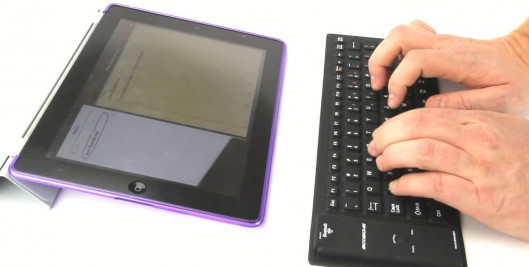

The keyboard surface reminds of the kind of spongy keys you'd find on a ZX Spectrum way back when, and to its left is a rectangular block that contains the Li-ion battery, power switch and mini-USB charging port. On the top of this block, there's a connect button flanked on either side by LED status and charge indicators.

The roll-up, splash-proof freeKEY comes shipped with a retractable USB charging cable and costs US$59.99.

Retro telephone gets 21st century update


While most phones are getting smaller and being crammed with non-phone functionality, the "Sixty" cordless phone from French company Sagemcom harks back to an earlier age of domestic communications ... with an injection of 21st Century design and technology.

The Sixty delivers a new twist on the 1960's Bakelite telephone by transforming the stocky rotary form into a folded, slimline design and adding a digital time fascia and capacitive touchscreen. The non-retro functionality includes hands-free calling, caller ID, 150 name and number phone book, phone conferencing, multiple languages, and an integrated digital answer machine.

The drilling bell tone of yore has been replaced with more modern polyphonic ringtones, although these include a reproduction of the original "ring ring" for those who want to retain some of the old-skool feel. There's also rotating lights and sound effects during dialing.

Monday, July 4, 2011

ArmKeypad – NEC developing tap-control interface for portable devices


Fiddling with small buttons or touchscreens on your mobile device when you're running, riding a bike or even just crossing the street can be a frustrating – and dangerous – endeavor. NEC is looking to solve this dilemma by developing a system that enables users to operate devices by just tapping their arm. The ArmKeypad is made up of acceleration sensors worn on each wrist that determine the area of the arm tapped by a user and translate this into different input commands via a Bluetooth link.

Announced by NEC and spied at Interaction 2011 by DigInfo TV, the system can detect whether the arm has been tapped by the left or right hand or if the user has clapped their hands. It can measure the strength of the tapping vibration and the tap's location on the arm.

One of the obvious applications is to control music while running allowing the user to stop and start the music, adjust the volume and select tracks.

Simpler and easier to learn that a gesture control systems, NEC says the commands are "easy to remember and are nearly free from input errors."

The company intends to refine the technology to about the size of a watch or wristband and a commercial version is expected in one or two years.

If tapping isn't your thing, you might have to hold out for systems that turn your arm itself into a touchscreen to reach maturity.

Medical tech company creates world's smallest video camera


Medigus has developed the world's smallest video camera at just 0.039-inches (0.99 mm) in diameter. The Israeli company's second-gen model (a 1.2 mm / 0.047-inch diameter camera was unveiled in 2009) has a dedicated 0.66x0.66 mm CMOS sensor from TowerJazz that captures images at 45K resolution (approximately 220 x 220 pixels) and no, it's not destined for use in tiny mobile phones or covert surveillance devices, instead the camera is designed for medical endoscopic procedures in hard to reach regions of the human anatomy.

The miniature cameras are made with bio-compatible compnents and are suitable for diagnostic and surgical procedures. Potential applications include cardiology, bronchoscopy, gastroenterology, gynecology, and orthopedic and robotic surgery.

"Medical procedures that have not been possible until now become possible with the world's smallest camera," said Dr. Elazar Sonnenschein, CEO for Medigus Ltd.

The camera will be integrated into Medigus' own disposable endoscopic devices as well as sold to third-party manufacturers.

Medigus says it will begin supplying camera samples to US and Japanese manufacturers in coming weeks.

South Korea to digitize all textbooks by 2015, provide tablets for school kids


South Korea’s Education Ministry has announced plans to trash the textbook tomes that weigh down the bags of students and replace them with digitized versions. Primary schools will be first, with their educational materials digitized by 2014, followed by secondary and high schools in 2015. The scheme, dubbed “Smart Education”, will allow students to read their materials on a variety of electronic devices, including smartphones, tablets, PCs, and internet-connected smart TVs. There’s no mention, however, of whether the project will also be rolled out to the students with the largest textbooks: undergraduates.

Some 2.2 trillion yon ($2 billion) will be spent on the project. The digitizing of educational materials will obviously consume some of that funding, but most of the money will probably be spent on the infrastructure for distributing the materials — i.e. tablets and smartphones for students. The South Korean government hasn’t revealed whether it will use a commodity tablet like the homegrown Samsung Galaxy Tab, or create a new device specifically for educational purposes. Given the planned cross-platform interoperability, though, it wouldn’t be surprising to see some kind of HTML5ish solution — and if that’s the case, then students will be able to use whatever tablet they like.

To back up this complete overhaul of the system the Education Ministry gave some interesting (but rather obvious?) facts about Korean students. Not only are they the most computer-literate students in the world, but according to a recent OECD report, they are also the most amenable to computer-based learning. “That’s why Korean students, who are already fully prepared for digital society, need a paradigm shift in education,” said an official from the Ministry.

The same OECD report, incidentally, showed that computer use at school didn’t actually have much of an impact on exam results. Computer use at home, on the other hand, created a much more marked improvement in results. The report goes on to suggest that computers should be further integrated into the teaching curriculum — and that’s exactly what Korea is now planning to do.

Genius wireless Ring Mouse released


Genius has announced the release of its Wireless Thumb Cursor Controller, or ring mouse for short. The clicking and scrolling action of the lightweight mouse replacement is thumb-controlled, its proprietary optical touch technology offers users 1000 dpi sensitivity and it's said to last a month between charges.

The 1.15 x 1.32 x 1.25-inch (29.3 x 33.7 x 32 mm), 0.42 ounce (12 g) Ring Mouse has 2.4GHz wireless connectivity with a range of around 30 feet (10 meters), and links to a USB nano/pico receiver slotted into a spare port on a Windows-based computer or laptop. Worn on the index finger, left and right click and optical touch control tracking technology are set around the top for thumb control of an onscreen cursor.

Although its primary use is likely to be controlling a projected presentation or photo slideshow, it should also prove useful as a travel laptop mouse, for those who regularly find themselves having to work in cramped conditions, or for those who just don't like to use a trackpad. The tracking sensitivity might also make it useful for mobile gamers.

Thin-film flexible 'Paperphone' created


Researchers from the Human Media Lab at Canada's Queen's University have created a fully-functioning floppy E-Ink smartphone, which they also refer to as a paper computer. Like its thicker, rigid-bodied counterparts, the Paperphone can do things like making and receiving calls, storing e-books, and playing music. Unlike them, however, it conforms to the shape of its user's pocket or purse, and can even be operated through bending actions.

"This computer looks, feels and operates like a small sheet of interactive paper," said its creator, Roel Vertegaal, who is also the director of the Human Media Lab. "You interact with it by bending it into a cell phone, flipping the corner to turn pages, or writing on it with a pen."


The device has a 9.5-cm (3.74-inch) thin film flexible E-Ink display, underneath which is a flexible printed circuit incorporating resistive bend sensors. Those sensors allow it to be programmed to recognize different types of bending gestures, which will subsequently result in it doing things such as navigating menus, making calls, selecting songs, or any other function. A built-in Wacom tablet also allows users to draw on its screen – making it even more paper-like.

When not actually being operated, the Paperphone consumes no electricity. Vertegaal's team have also created a similar device, the Snaplet, which can be worn like a wristband. It operates as a watch when in a convex state, becomes a PDA when flat, and can be used as a phone when turned concave.

The technology is the result of a collaboration between Queen's University and Arizona State University. "This is the future," said Vertegaal. "Everything is going to look and feel like this within five years."